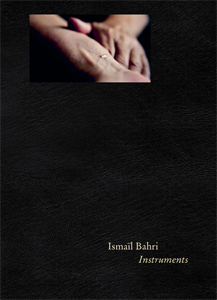
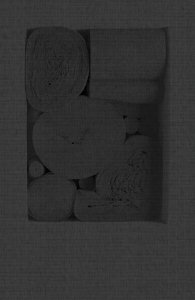
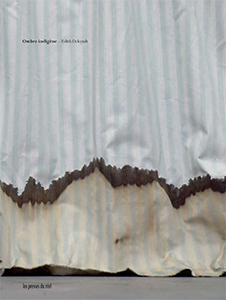
Instruments is the catalogue accompanying Ismaïl Bahri's exhibition of the same title at the Jeu de Paume. It is also his first monograph. Bahri's oeuvre, which dates back to the 2000s, is like a precise and sensitive record of events and experiments; its often mechanical kinetics are particularly evocative of the
film process. His experiments are based on the tiny nuances and minute developments that occur when simple things are brought into contact with each other. They demand an acuteness of gaze that leads one to question the limits of perception and the visible.
The work of Ismaïl Bahri (born in Tunis in 1978) cultivates slowness. It is based on a close exploration of simple elements and the often tenuous reactions that occur when those elements are brought into contact. The artist runs through series of small gestures, repeating them assiduously – he activates things, sets them in motion, transforms them, ties things in knots, crumples them – and he welcomes the unforeseen developments that ensue. His works, which are mostly
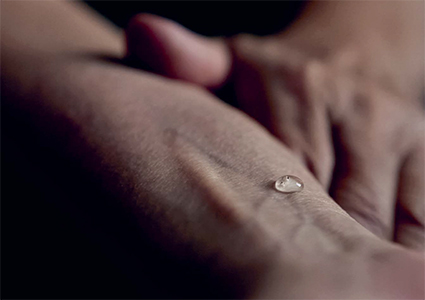
videos, can be seen as a translation into images of those experiments, retaining the most significant effects. A drop of water that reacts to organic intensities (
Ligne); a page from a magazine that loses its pigment and stains the fingers that handle it (
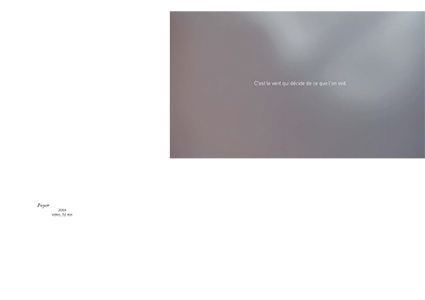
Revers); a blank sheet of paper that becomes coloured in the light (
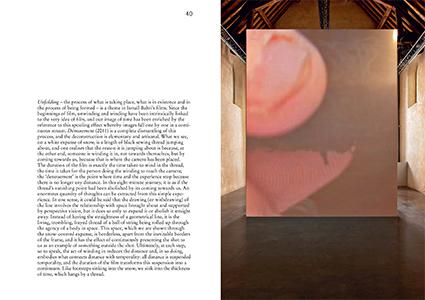
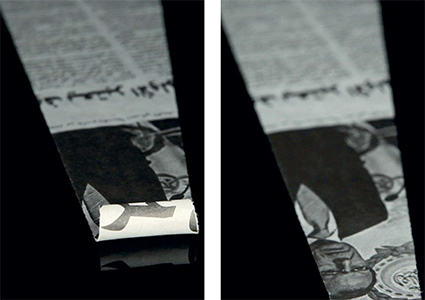
Foyer); a thread being rolled up into a ball (
Dénouement). These transformations are all about detail and tiny events; they require us to pay careful attention. In Ismaïl Bahri's work, it is in that moment of perceptive focus, poised on a tightrope between preciseness and insubstantiality, that the force of things and their potential for variation emerge.
The
instruments – those sensitive objects that enable us to function in the physical world – act as the intercessors of Bahri's actions. The elements he uses – water, thread, cloth, ink, light, wind, hands – are brought into play for their ability to affect and be affected by their surroundings. Consequently, notions of impregnation (
Foyer), nuance (
Sondes), development (
Source), capillarity (
Film), transfer (
Revers) and revelation (
Esquisse, for E. Dekyndt) are recurring motifs in his practice.
Held at the Jeu de Paume, Paris, from 13 June to 24 September 2017, the exhibition
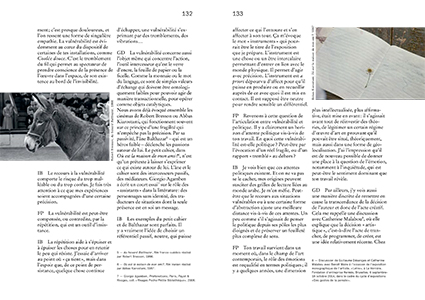
Instruments, the first of this scope devoted to Ismaïl Bahri, features a selection of eight recent videos, three of which were produced for the occasion. The accompanying catalogue, the first monograph to be devoted to the artist, presents a larger number of videos, as well as other creations – photographs, drawings and installations – encapsulating his entire practice since his earliest works in the 2000s. An essay by Jean-Christophe Bailly provides an overview of his oeuvre, while a discussion between Ismaïl Bahri, Guillaume Désanges and
François Piron puts his approach into perspective, shedding light on his work methods and influences. Finally, commentaries by Marie Bertran focus more specifically on the works on display at the Jeu de Paume.
Published on the occasion of the eponymous exhibition at Jeu de Paume, Paris, from June 13 to September 24, 2017.
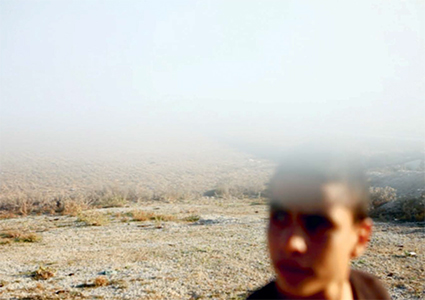
Ismaïl Bahri (born 1978) studied art in Paris and Tunis, his birth town. He works in both cities. Bahri works with video, drawing, sculpture and sound, without confining himself to any particular medium. He positions himself as an observer in order to create a framework for capturing gestures and empirical experiences, paying attention to "what is happening". His work explores the meaning that emerges at the periphery of vision, and the presence of the surrounding world as it manifests itself and reveals itself.
His works have been exhibited internationally at institutions such as the Centre Pompidou, the
Jeu de Paume, the Museo Reina Sofía, the Espace Khiasma, the Beirut Art Centre, the Staatliche Kunsthalle in Karlsruhe and the IVAM (Institut Valencià d'Art Modern). His films and videos have been screened at international festivals and events, including the Toronto International Film Festival, the New York Film Festival, the Rotterdam International Film Festival, FIDMarseille and the Kunstenfestivaldesarts. His work has been exhibited at international biennials, notably the 11th Sharjah Biennial (2013) and the 13th Sharjah Biennial (2017), the Gherdëina Biennial in Italy (2024), and the Dakar Biennial in Senegal (2026). In 2023–2024, Ismaïl Bahri was an artist-in-residence at the Villa Medici (French Academy in Rome).