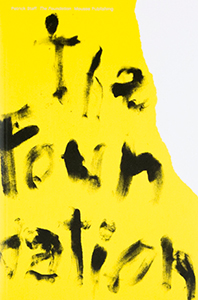
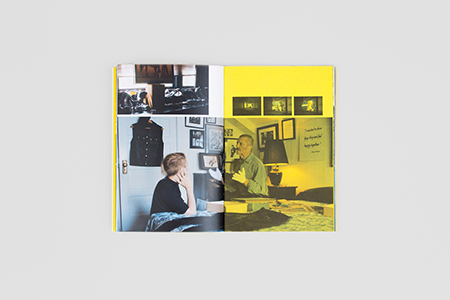
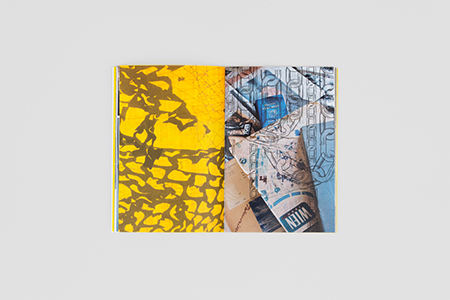
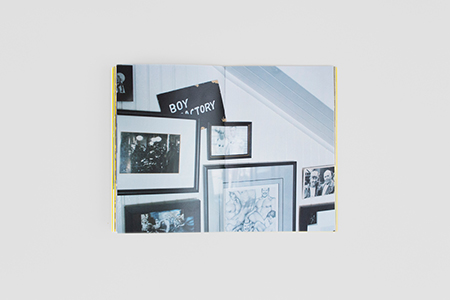
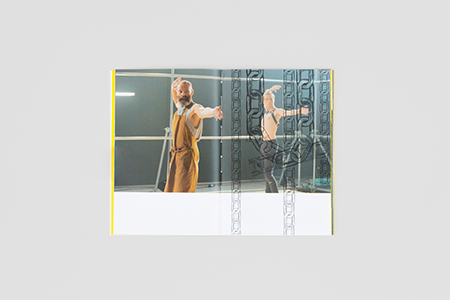
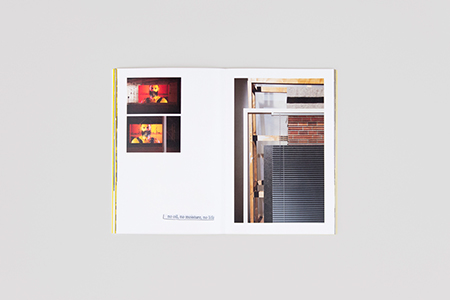
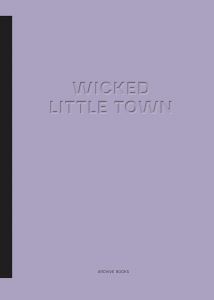
This book documents the eponymous work by British artist Patrick Staff a film installation exploring
queer intergenerational relationships negotiated through historical materials. The film combines footage shot at the gay icon Tom of Finland's Foundation in Los Angeles with choreographic sequences shot within a specially constructed set.
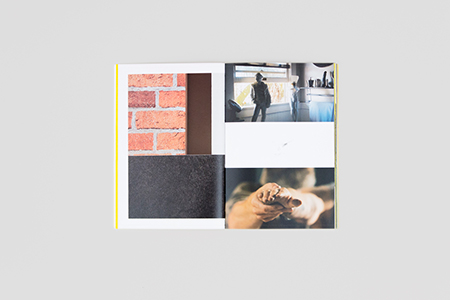
The film The Foundation combines footage shot at the Tom of Finland Foundation in Los Angeles—home to the archive of the erotic artist and gay icon and a community of people that care for it—with choreographic sequences shot within a specially constructed set. The legacy of Finnish artist Touko Laaksonen (1920-1991), better known as Tom of Finland, spans multiple generations. Tom of Finland's work made a considerable impact on masculine representation and imagery in post-war gay culture. Rather than focusing on Tom of Finland's work, Staff's film evokes the foundation as a set of relations. Staff explores how a collection is formed and constituted; the communities that produce and are produced by a body of work; and ideas of intergenerational relationships and care. Through observational footage of the house, its collections and inhabitants, the foundation is revealed as a domestic environment, a libidinal space, archive, office and community centre; a private space which is also the home of a public-facing organisation and the source of a widely dispersed body of images.
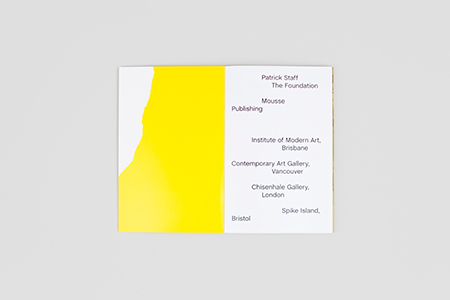
Published following the installation's touring exhibition at Chisenhale Gallery, London; Spike Island, Bristol; Contemporary Art Gallery, Vancouver; and the Institute of Modern Art, Brisbane, in 2015 and 2016.
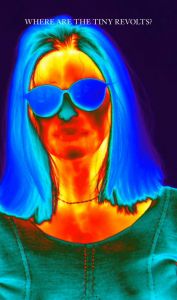
Born 1987 in Bognor Regis (England), P. Staff lives and works in Los Angeles. Through installation, video, sculpture, performance and poetry, Staff's work explores the ways in which history, technology, capitalism and law transform the constitution of contemporary bodies, their tissues, their minds, and their social spheres. With a particular focus on desire, debility and dispossession, their practice mediates current biopolitical and necropolitical configurations through which bodies—particularly those belonging to marginalized communities—are disciplined and disregarded.
Distinct in its refinement, criticality, and timeliness, Staff's practice is eminently contemporaneous, both in its choice of media and materialization—from holographic film installations to sculptures made using cutting-edge scientific methods—and in its critical engagement with visible and invisible showings of violence and agency.
The exhibition space itself has increasingly become a central medium in their artistic practice. Elements such as lighting and color—along with the somatic and sensory experience of entering, moving through and exiting a space—are meticulously choreographed to create intense, sometimes unsettling, always profoundly affecting atmospheres.